We begin with the listening goal
The first prototype answers what the process should sound and feel like. Algorithms, parameters and ranges are judged as musical decisions before they become a polished product.
Turn a sonic idea into stable software that musicians can understand and trust.
Digital signal processing design and audio plugin development for Audio Units and VST3, including prototyping, product UI, host testing, optimisation and release support.WHO THIS IS FOR
Audio technology companies, instrument makers and product owners turning a sonic concept into professional software.
WHY WE ARE DIFFERENT
Audio software succeeds when the signal path, control model and musician's mental model agree. We develop DSP, plugin architecture and product interface together, then listen and test inside real host applications. That avoids technically interesting processing hidden behind a generic interface or a beautiful interface disconnected from the sound.
The first prototype answers what the process should sound and feel like. Algorithms, parameters and ranges are judged as musical decisions before they become a polished product.
Controls, visual feedback, modulation and presets are designed around useful decisions rather than exposing every internal variable to the musician.
Automation, state recall, resizing, sample-rate changes, latency, bypass and format requirements are checked as part of development—not left to the release candidate.
THE TECHNOLOGY NOW
The plugin market expects cross-format delivery, high-resolution and resizable interfaces, dependable preset and state handling, accurate automation and efficient DSP across varied host environments. The engineering challenge is not only the algorithm; it is the complete contract between signal, host, interface and user session.
Each format defines discovery, state, buses, parameters and host communication differently. A shared DSP core still needs format-aware wrappers and testing.
Saturation, filters and dynamics can benefit from higher internal rates, but quality choices must be balanced against latency, aliasing, CPU and real-time safety.
Smooth automation, tempo relationships, parameter ranges and modulation depth must behave predictably in both the interface and the host timeline.
A responsive interface, clear metering and fast preset or state exploration can materially change how often a powerful process becomes useful music.
WHERE IT IS GOING
Audio products are moving towards more expressive modulation, spatial and multichannel processing, intelligent assistance and deeper hardware or controller integration. A clean DSP and state core lets a product adopt those changes without destabilising the sessions that already depend on it.
We plan for likely change without making your project depend on a prediction.More scalable interfaces serving high-density monitors, touch devices and accessible control paths.
DSP components reused across plugin, standalone, embedded and real-time interactive environments.
Selective machine learning used for analysis, control or modelling where it improves a defined audio task.
Stronger automated validation around state compatibility, hosts, formats, sample rates and performance budgets.
CUSTOM VS OFF-THE-SHELF
A framework can supply windows, parameters and format wrappers, but it cannot decide the signal architecture, interaction model or product identity. Custom work matters in the DSP, musical control, modulation, visual feedback and exact behaviour that makes the plugin worth choosing.
Stock processors and licensed modules can prove a product category quickly but may limit tuning and distinction.
DSP is developed and voiced around the product's intended sound, control range and performance budget.
Generic parameter panels expose capability but rarely create a memorable or efficient musical workflow.
The interface groups decisions, explains behaviour and gives the signal path a distinctive product language.
A framework solves common mechanics, but host, state, automation and performance still depend on the implementation.
Testing covers representative hosts, formats, sessions and failure cases with the technical owner close to the code.
We will say when an existing product is the sensible answer. Custom work should earn its place through fit, control, integration or long-term value.
HOW WE HELP
You can engage us for one focused capability or a joined-up delivery. We shape the work around the outcome, handover and level of support you need.
Signal-path exploration, algorithm selection, listening tests, parameter ranges and performance measurement.
AU plugin products for Apple host environments with state, automation, bus and interface behaviour tested in context.
VST3 instruments and effects with clear parameter models, host integration, presets and cross-platform planning.
Plugin UX, visualisation, preset workflow, installers, validation, documentation and launch support.
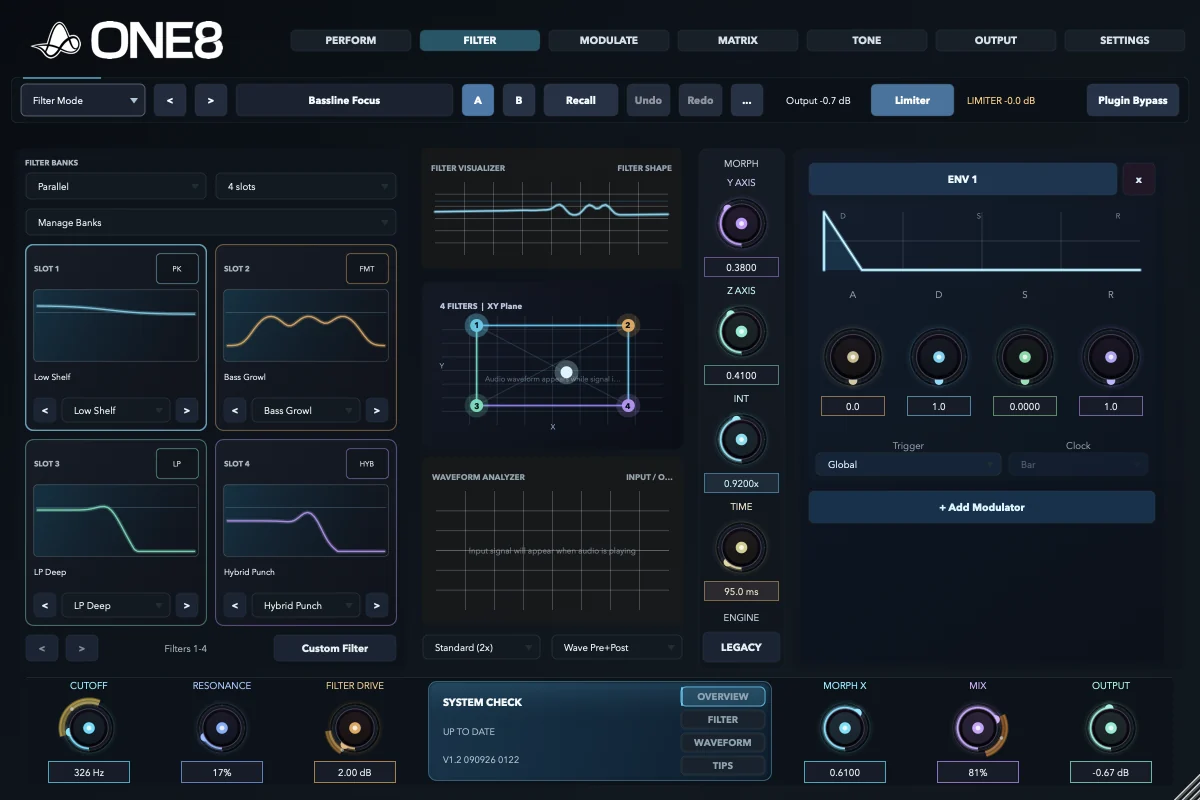
ONE8 AUDIO PLUGIN
ONE8 turns four filter states, movement, routing and detailed control into a focused morphing-filter workflow for musicians.
Visit Wahida Audio ↗HOW WE WORK
Describe the audible result, musician, use case and constraints before selecting algorithms.
Build and listen to the signal core before polishing controls around the wrong behaviour.
Connect parameters, modulation, visual feedback, state and presets into one coherent interaction model.
Profile real-time performance and test formats, hosts, sessions, installers and upgrade behaviour.
RELEVANT WORK
PRACTICAL QUESTIONS
VST3 and Audio Units are core areas of the offering. The target operating systems, hosts and compatibility matrix are scoped explicitly; do not assume every platform is included.
Yes. ONE8 demonstrates the supplied scope of DSP, plugin, interface, website and authentication-linked customer portal. See its relationship disclosure in the case study.
A project plan should specify host compatibility, state recall, automation, sample-rate changes, latency and real-time behaviour. The exact test matrix is agreed for your product.
A CLEAR NEXT STEP
Bring the current workflow, product or technical problem. We will help define the sensible route, what should stay off-the-shelf, where custom work earns its place and how to prove value before scaling.
Start the conversation ↗