Sound starts with gameplay information
We identify the states, surfaces, speeds, threats, distances and priorities the audio system needs before authoring events or asking developers for hooks.
Make sound respond to play, space, state and story instead of simply starting a file.
Game audio design and middleware implementation using FMOD or Wwise, including events, parameters, spatial audio, mixing, profiling and engine integration.WHO THIS IS FOR
Game audio design and middleware implementation using FMOD or Wwise, including events, parameters, spatial audio, mixing, profiling and engine integration.
WHY WE ARE DIFFERENT
We combine audio design with the code and implementation thinking needed to make it work in a running game. Assets, events, parameters, routing, mix states and gameplay hooks are designed together. That reduces the gap between a good sound library and an audio system that actually communicates what the game is doing.
We identify the states, surfaces, speeds, threats, distances and priorities the audio system needs before authoring events or asking developers for hooks.
Event naming, buses, parameters, snapshots and ownership follow a documented architecture so the project remains mixable as content multiplies.
Voice limits, streaming, spatial settings and optimisation are judged alongside the creative result. Performance is not allowed to quietly redesign the mix at the end.
THE TECHNOLOGY NOW
FMOD and Wwise give audio teams direct control over event logic, variation, transitions, routing, profiling and live mixing. Their value is greatest when the middleware model and engine data agree: parameters arrive consistently, object lifecycles are predictable and the mix reflects gameplay priorities.
A gameplay event can contain layers, randomisation, transitions, effects and conditions that create variety without handing every decision to engine code.
Speed, health, surface, tension, distance or environment data can shape audio smoothly rather than switching abruptly between disconnected assets.
Designers can connect middleware to a running build, adjust events and mix decisions, and judge changes in the context where they matter.
Voice count, CPU, memory, streaming and event behaviour should be inspected continuously on representative hardware, not only during final optimisation.
WHERE IT IS GOING
Interactive audio is becoming more procedural, spatial and data-driven, with one system expected to serve speakers, headphones, accessibility options and haptics. The strongest projects will give audio teams better authoring control while keeping runtime behaviour, budgets and ownership explicit.
We plan for likely change without making your project depend on a prediction.More reusable, parameter-driven systems replacing large collections of near-identical one-shot assets.
Closer coordination between object audio, acoustics, animation, physics, accessibility and haptic feedback.
Procedural DSP and sample-based sound working together to reduce repetition while retaining art direction.
Platform mixes derived from one coherent intent rather than treated as unrelated final-hour exports.
CUSTOM VS OFF-THE-SHELF
Asset libraries are valuable ingredients and middleware supplies proven authoring tools. Custom implementation earns its place in the sound language, parameter mapping, event architecture, engine integration and mix behaviour that make one game feel different from another.
Library assets are fast and clean but can make important moments feel familiar or disconnected from the world.
Original recording, processing and consistent event design build a sound language tied to the game's materials and story.
A file starts when a trigger occurs, with limited connection to player state, movement or environment.
Parameters, layers and transitions make the result respond continuously to what is actually happening.
Behaviour can become scattered between engine components, blueprints, scripts and project settings.
A clear middleware architecture centralises events, routing, mix states, variation, profiling and debugging.
We will say when an existing product is the sensible answer. Custom work should earn its place through fit, control, integration or long-term value.
HOW WE HELP
You can engage us for one focused capability or a joined-up delivery. We shape the work around the outcome, handover and level of support you need.
Events, parameters, banks, buses, snapshots, live update, profiling and integration with Unreal or Unity.
Actor-mixers, events, states, switches, RTPCs, routing, profiling and engine-side integration.
Emitters, listeners, occlusion, room behaviour, priorities, voice management and target-platform tuning.
Music states, dynamic range, priorities, snapshots and output strategies that keep important information readable.
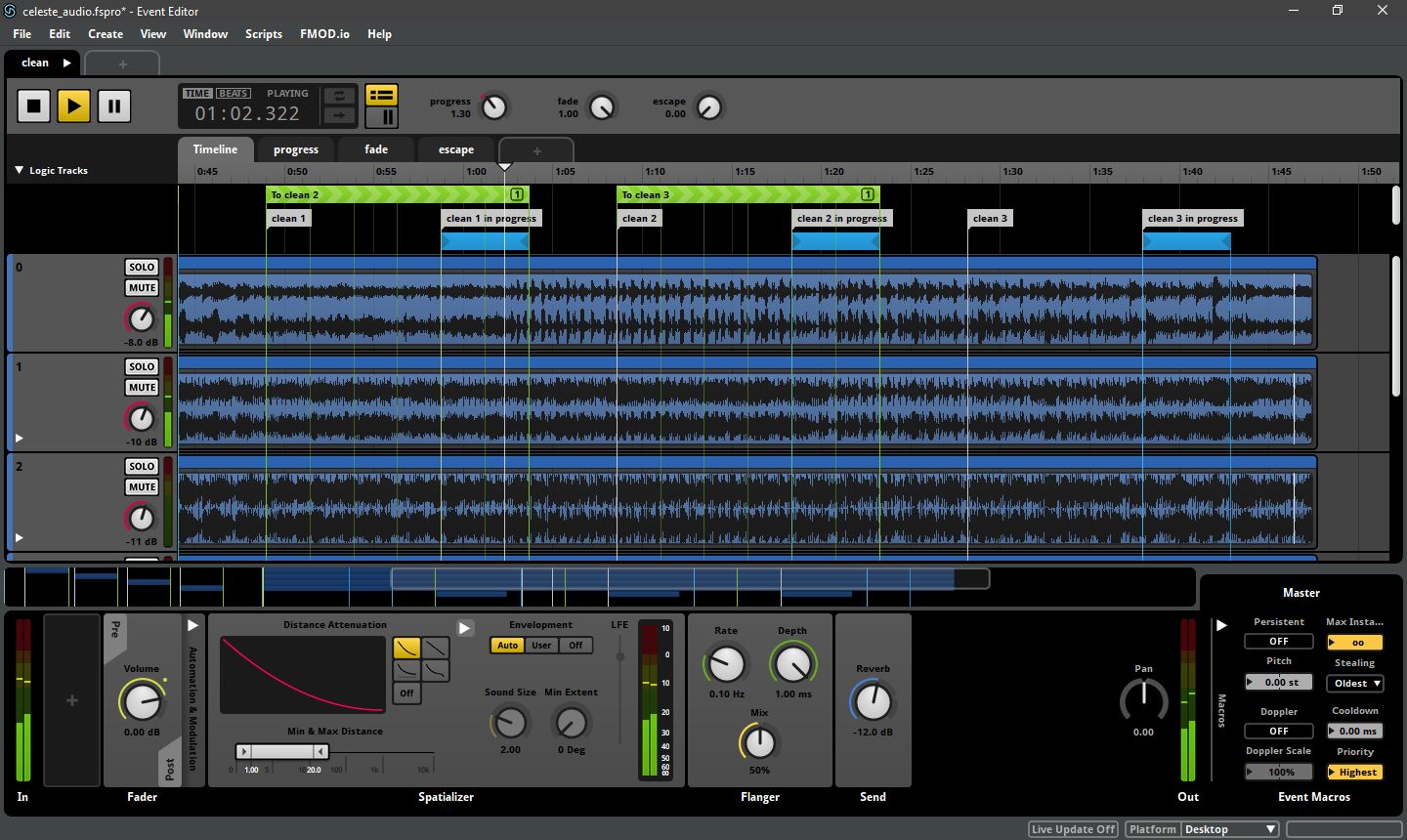
FMOD MIDDLEWARE
Events, parameters, routing and spatial behaviour are authored as part of the experience and tuned while the game is running.
Explore FMOD Studio ↗HOW WE WORK
Identify the information, transitions and priorities the audio system must express.
Define events, parameters, routing, naming, banks and engine responsibilities before production scales.
Build assets and middleware behaviour together, listening inside the running experience.
Tune voices, memory, performance and output mixes on representative target hardware.
RELEVANT WORK
PRACTICAL QUESTIONS
Yes. We agree the deliverables, acceptance criteria and handover for a focused engagement or combine it with other disciplines where useful.
An outline of the goal, existing materials, important dates and any technical or commercial constraints. Confidential details can wait until suitable terms are agreed.
Fees depend on scope and delivery requirements. We provide a proposal before work starts, including responsibilities, assumptions, third-party costs and tax treatment.
A CLEAR NEXT STEP
Bring the current workflow, product or technical problem. We will help define the sensible route, what should stay off-the-shelf, where custom work earns its place and how to prove value before scaling.
Start the conversation ↗